The North and South Divide

Imperialist appropriation in the world economy: Drain from the global South through unequal exchange, a peer-reviewed by Jason Hickel, Christian Dorninger, Hanspeter Wieland, Intan Suwandi is being promoted on LI.

The problem with peer-review is that the review is carried out by . . . peers, who all think alike and seem incapable of critical thought applied to one of their own.  So, for those who can’t be bothered to read the article (you don’t have to buy it to read it, but you will need a strong stomach) here is a summary of the problems contained therein.

1 – decarbonisation has nothing to do with colonialism.

2 – the authors are not referring to colonialism, but to free market trade, the buying of goods, raw materials and natural resources in low-cost countries, and their export to high-cost countries.  In other words, this is business as usual.  All countries have been colonies at some point in their history (including Ethiopia and Afghanistan, but not some of the Andaman Islands), so to dwell on colonialism is pure political propaganda. 

3 – the global North and South referred to are not geographic definitions but financial selections, with the “bad” guys the expensive countries and the “good” guys the cheap countries.  Inevitably, North countries with a high cost of living and high wages will import produce from South countries with low cost of living and low wages and easy availability of raw materials.  Even in a South country, goods and services are bought from low cost sources and shipped to locations of relative scarcity where the value is higher.  It would make no sense to do anything else.  Is Saudi Arabia going to buy petrol from Total in France at €2 a litre tax paid, when it can pull a barrel (160 litres) out of the soil for €4 ?  Is Chile going to produce copper from the middle of the Atacama desert where copper is present and where there are few environmental considerations, or buy copper from deep mines in Cornwall and their smelters in South Wales ?

4 – the authors then proceed to total the value of all the goods sent from the South to the North, goods which were paid for at freely-negotiated (market) rates.  They then subtract the actual value of the goods from a theoretical value if the goods had been exploited, processed and produced in the North at prevailing higher northern prices. 

The authors then claim that that difference ($Trillions) is somehow lost to the South, where it could have ended global poverty, cured malaria, and given everybody a swimming pool and a Mercedes-Benz.  They ignore that if there was no price differential, the trade would not take place at all.  All goods are paid for, the South receives cash or other goods (especially arms and ammunition).  The authors do not calculate the investment necessary to produce these goods, or to raise living standards and wages to Northern standards, both of which are legally possible for the South nations in question, but whose governments (mostly democracies) refuse to carry out.

5 – the authors compare this economic drain from the South to the aid received from their Northern partners, but that is irrelevant, as aid is not supposed to alleviate the harm done by such trading practices, but to encourage those governments to maintain the free trade agreements which permit them, and the democratic or pro-North policies which permit Northern countries to grant them aid.

6 – the authors fail to mention any global laws that prevent Southern nations from becoming a Northern power.  Any country can become an industrial powerhouse, as Israel, Taiwan, Singapore and South Korea have all done since 1960.  There is no reason why Argentina, Chile and Brazil could not have copied Australia and New Zealand, all countries with similar agricultural backgrounds and latitudinal geographies, but one group in South and the other in North.

The purpose of this work seems to be to produce a corpus of mutually-reviewed documents, which allow researchers to seek funding from governments, enterprises and agencies seeking to portray themselves in a positive light when audited for social responsibility and ethics.  Governments can use this material to impose ethical taxes on enterprises participating in such business, and grant some of the revenues raised in additional aid, while squandering the rest on war and luxury.  Enterprises can carry out whitewash marketing to go alongside their greenwashing, and promote themselves as more ethical because they “buy in the USA”, for example, even though, as the authors rightly point out, the produce is assembled in the US from components sourced in Bolivia and China.  And aid agencies and the charities that depend on them will scream for more funds while waving this paper in front of politicians who have not read it critically.  Mainly, the South countries can demand reparations and refer to this article, whose authors will receive invitations to speak at many events.  The attempt to link this kind of financial drain to climate change, itself the subject of massive misrepresentation, is just another way of increasing the funds they can claim.

There are many problems associated with this kind of academic bullshit and its uncritical repetition, not least that the real problems of the world go unresolved while resources are squandered on pointless political propaganda.

Saudi Arabia, Qatar, Bahrein are included in the South, while Iceland and Ireland, countries with almost no natural resources, are included in the North.  The authors’ “unequal exchange” produces a financially-quantifiable loss to the South and drives “global inequality, uneven development, and ecological breakdown” demanding some form of reparation.  This conclusion is just preposterous.  Unfortunately, this kind of research is what gives LSE such a bad reputation, at least among those who think clearly.

If you swear allegiance to authority, can you still criticise it freely when it does something illegal, wrong or dangerous ?

The coronation service of Charles as king of the United Kingdom will include a pledge of allegiance. 

It is only 80 years since the Nuremberg Trials in which Germans defended their actions of confiscation, imprisonment, mutilation and murder by claiming that they were merely following their pledge of allegiance and the blind obedience it obliged.  Now Britons are lightly invited to swear allegiance.  There is no penalty (at present) for those who refuse but, given the current debate about whistle-blowers and the power of authority vested in management and government, it raises the question – is duty to our superiors absolute or should we also consider other duties to ourselves, to our fellow men and women, and to the environment ? 

A pledge of allegiance may seem a quaint remnant of a feudal past, a brutal attempt at oppression, or a demand typical of a fuddy-duddy unsure of his place in the world.  In behavioural terms, the act of swearing allegiance could be either an autonomic reaction to a humiliating demand wrapped up in ceremonial patriotism, or the careful and cynical output of a cost/benefit analysis, while the choice of resisting or swearing should result in greater fitness for the individual for the behaviour to survive in the population.  Could these behaviours result from the same stimulus with merely the experience of the human in question providing the difference ?

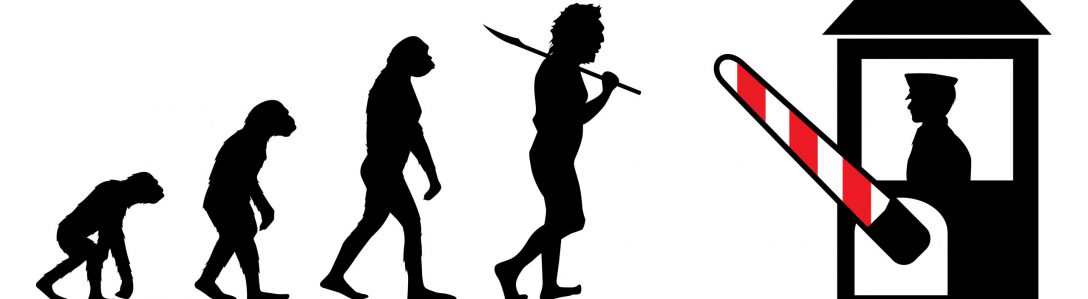
Submission to authority, the overt admission of inferiority, is usually signalled by a pointless or humiliating obeisance.  If it were entirely beneficial or immediately profitable, there would be no qualms about pledging.  As I describe in my book Tax Man, paying homage to those who claim authority is ingrained in human nature, programmed in our genes.  It permits the formation of government, with the first demand for submission being followed by demands for labour or military service, and a financial contribution or supply of produce.  The tax revenues and armed forces are the foundation of government. 

The first time someone makes a specific demand for submission, an adult male may resist to the extent of using force.  Those who demand submission have now thousands of years of experience in managing the process.  Any resistance is usually quashed with, if necessary, confiscation, imprisonment, mutilation and even murder, reducing the fitness for survival of a resisting individual by their temporary or permanent removal from the gene pool.  Once the submission is gained, governments use the acquiescence to implement taxes, which again, the first time, may need to be enforced violently.  It is a trait of humans that, once they have paid a tax once, they continue to pay without question until the tax rate goes up, the name changes or a new tax is introduced.  Taxes become customary, like customs.  So, the initial demand for submission, even if it is only an invitation to pledge allegiance, has enormous consequences – good and bad – for the individual and for the state.

Submitting to authority as a behavioural trait would not have survived thousands of years of human civilization if it did not grant its actors with greater fitness for survival than they would gain by resisting, or by living in a culture where such demands do not occur.  Demographic study of the global population show that the greatest population growth has occurred in areas – China, India/Bangladesh/Pakistan, and north-western Europe – where submission to authority has been greatest.  Studies of ruling elites are also pretty convincing that those who strive to operate as tax-collectors are less prolific than simple tax-payers.  So, pledging allegiance may be a good thing in the long term for those submitting to the humiliation.

The reason for the demographic success of submission is that human males are aggressive animals who would otherwise fight for territory and mating rights.  Nobody would invest in the improvement of land or build roads and bridges or develop new technology, all of which makes life as we know it so good for so many people, unless such investment was protected.  The process of submission grants the individual the right to property, work and family without (much) further interference.  Typical feudal taxes specifically permitted the individual to sow his corn and harvest the crop, and laws like Magna Carta (now long-since repealed) prevented the government from imprisoning the individual or confiscating his tools so that he could not work.  In return, he would be expected to pay his taxes.  Women did not have to pay taxes, provide military service or perform corvée labour to build or repair roads and bridges, so they appear rarely in the evolution of these behaviours.

Although submission to older or more powerful males is a normal mammalian trait within the family, it is unusual in intergroup interactions, between strangers, where the normal behaviour is fight/flight/freeze.  In such a situation of fight, flight or freeze, it would impossible to cooperate in groups larger than a family.  Humans have evolved to inhibit this reaction and substitute it for an aggressive but usually non-violent process of agreeing relative authorities between strangers.  Submission to alien authority permits much larger groups of humans to cooperate, to build, trade or invade neighbouring countries, which in turn lead to much more rapid and significant technological changes and improvements in the food supply, sanitation and healthcare.  From economic and demographic points of view, therefore, a pledge in itself is a good thing.

Those who criticise the pledge for philosophical reasons may be surprised to discover that they are already guilty of such servile behaviour, eagerly signing up to pledges to democracy, the Labour Party, environmental campaigns, animal activism, vegetarianism, climate emergency or pacifism.  Any interaction with government, be it through the police, civil service, or the Inland Revenue, inevitably starts with some equivalent.  The police officer will, perhaps politely, issue a request to turn off the car engine or the radio, open the door, or present identity papers.  A civil servant will only countenance an interaction with someone who has booked an appointment, or joined a queue, or correctly filled in a form.  Teachers have to be addressed as “Sir”, judges as “my Lord”, kings as “Your Majesty”.  Any refusal to do so will invite the pre-programmed reaction by the superior authority, which leads quickly through aggression to violence, with the full support of the entire governmental bureaucracy and the general public.

British children grow up with no specific pledge of allegiance to nation, state or sovereign.  In addition, there is almost no legal protection of the royal person, hardly surprising in a country where Parliament is a regicide.  The laws on high treason (attacks on the king), treachery or even petty treason, such as the prohibition on a wife to attack her husband, have all been repealed, so that, in general, and in theory, we are all equal before the law.  However, all Britons today pay taxes, even if the majority of their earnings come from taxes.  Acquiescence to taxation is just as much an overt submission to authority as a pledge of allegiance, and just as difficult to refuse after it has been done the first time.  Britons also acknowledge government power when requesting a passport or driving licence.  Citizenship or residence is essential for even the most menial of tasks especially for foreign travel and formal employment, and beneficial for marriage.

The pledge to the British king is little different from that to Adolf Hitler, promising blind obedience, although the German pledge is explicitly unto death in most Nazi-era oaths.  The royal pledge is not overtly so final, but any oath of allegiance implies blind obedience, and blind obedience is only an order away from a suicidal last stand or a murderous raid.  Military officers already operate under a pledge of allegiance, granted perhaps passively in the commission document signed by the sovereign, but enforced in daily rituals such as saluting and raising the flag.  Civil servants sign their letters to superiors “your humble and obedient servant”.  Scouts and guides, police officers, judges, notaries, and immigrants seeking naturalization likewise have to pledge allegiance.  British Members of Parliament (MPs and Lords) have to swear allegiance to the sovereign before they can speak, which is why Sinn Fein MPs refused to take up their seats.  Curiously, Charles, while still a prince, did not swear allegiance to the Queen as a member of the House of Lords.

Britain’s allegiance to the Crown is replaced in republics by allegiance to the flag and the republic, sworn as in Nazi Germany by schoolchildren.  Americans are surprised when they see photos of Britons wearing Union Flag shorts or swimming trunks, which for Americans would be a desecration of the national flag.  Most countries have laws prohibiting flag desecration or even interfering with the national anthem, although in Britain desecration of inanimate objects is allowed.  In Islamic countries, mockery or even representation of the Prophet or Allah would also be considered desecration and subject to punishment.

While some will swear allegiance to Charles as the head of state, others will swear allegiance to Charles as the head of the Church of England (although he has no formal role in Anglican churches in Ireland or elsewhere).

Only a very few will actively challenge the pledge.  Guardian readers, anarchists, and modern thinkers may be surprised to learn from polls that 20% of the British population will make the pledge.  Some of these will no doubt mouth the pledge of allegiance while deprecating its importance.  This is disingenuous; the importance is that it is done, not overtly refuted.  Crossing one’s fingers will not minimise its psychological effect.  As far as the human behaviour is concerned, not challenging the pledge is equivalent to making it.  Social peer pressure will do the rest.  As long as no overt denial is made, it is implicit submission, just as people who witness racist or sexist actions are by their inaction supporting the actions of the perpetrators.

The result of only a small population making the pledge (explicit submission) and a large majority acquiescing (implicit submission) will be a continuation of the monarchy as a component of the British constitution.  When individual compliance to a particular situation is sought by government, an explicit submission will be enforced by those who have pledged, supported by the entire edifice.  It is difficult as an individual to stand up to the police, prosecutors, judges, a jury, the media and even friends and family.

In a smaller way, pledges of allegiance to a superior in a hierarchy create similar ties of blind obedience and powers of enforcement.  The pledge does not need to be overt, it can be just the omission of an overt refusal, or an overt acceptance of some brutal enforcement.  It need not be a formal event, such as in a Mafia family, or in a formal document, such as an employment contract.  Organisations, especially religious or political ones that do not have a specific profit motive, can easily turn their power of oppression on their employees, customers or neighbours.  Critics, who may number only a few, will be powerless to prevent such actions.  How can one blow the whistle on someone to whom one owes allegiance ?  Especially if, as a result of swearing allegiance, one has gained wealth, influence and a family ?

Life may be unfair, unjust and painful to watch.  Oppressive organisations may make individuals suffer.  The power of superiors to bend inferiors to their will is unlimited.  If history has shown us anything, it is that those individuals involved directly, who are usually the most vociferous in criticising, and those most active in climbing the hierarchy, suffer the most.  For the rest of us, observation and seizing the opportunity for a good life is the right strategy.

Recommendation for Saturday ?  Switch on the television and enjoy the best soap opera there is, but put in an order for that passport from Paraguay.
Slavery descendents’ demands for reparations from Britain make no sense

Asking the British government for reparations for slavery makes no sense.

First of all, Britain was the first country to ban the slave trade, precisely because it did not bring in any wealth to the British government, and it enforced it.  It was also one of the first countries to ban slavery and it enforced it throughout the Empire, a quarter of the world at the time.  England had already banned slavery after the Norman Conquest, again because the king did not receive any money from slaves.

Second, the British participated in the slave trade, but they did not enslave Africans.  They merely transported them from Africa to America, and the British were the most efficient operators of ships at the time.  These were private ventures, not state operations. If Jamaicans or other descendants ask the British government for a one-way ticket to Nigeria, then perhaps they will get it, out of kindness, but not from any legal obligation.  It is funny that since the foundation of Liberia so few African-Americans have wanted to return.

Thirdly, the culture in many Niger-Congo nations was that if you took part in a war and lost, you became a slave.  Free Africans became slaves because they took up arms, and lost, and they were enslaved by other Africans, not by the British.  If reparations should be paid, it would be by African slavers, especially the Kongolese and Dahomeans who deliberately set out to invade their neighbours’ lands to capture slaves. Good luck with that one.

Slave descendents benefited in many ways by being transported by the British. A journey to British colonies or the USA was preferable to the castration and sex-slavery of the Constantinople slave market, or the poverty of their home country. British destinations also granted their descendents the preferable passports of today, whereas their counterparts in French or Spanish ships have to contend with passportf from Venezuela, the cocaine triangle, or Haiti.  A slave’s descendents living in the United States benefit from an average salary of $75,000 a year, almost ten times the average salary in Nigeria.

why do people act too late to prevent disasters?

As Prof Nigel MacLennan, Leadership Coach and Investor keeps asking this question, (https://www.psychreg.org/climate-inertia-psychology-acting-too-late/) I have finally got around to answering it.

In the research for my latest book about Famine in the British empire, I discovered that many people affected were unwilling to change their diet, their work practices or their abode, even though any of these would have mitigated or even avoided the problem. I struggled to understand why this might be so, until I watched a TED talk in which the presenter mentioned that in any situation requiring change, only 7% of humans will adapt. In other words, although we often claim that human success (in population or biomass terms) is due to our adaptability, in fact it is only a small minority of humans who do adapt, the rest merely benefiting from their actions, or dying.

Most human behaviour is driven by genes, upbringing and peer pressure, not by rational decision-making. Freud was the first person to posit this as a kind of scientific theory, but it has since been proven. In practice, people start to carry out a new action and only later use their brains to justify their actions. Best-selling books pander to the idea of Homo sapiens, but there is just no evidence to support the idea that most humans are rational creatures. The vast majority will do what they have always done, and if they are going to change their behaviour, they will just follow the crowd. No amount of intelligent reasoning will make them adopt a course of action that is not approved of by their previous experience or by those around them.

Leaders in hierarchical organisations are even less likely to succeed by appealing to intellectual arguments. Hierarchical organisations encourage sycophancy, not open discussion and rational thought. Those highest in the structure are also those least likely to have the time to investigate any specific thing, and those least likely to have as advisors people who want the best for the planet, the human population or the organisation they work for – they are only interested in getting the promotion to the top job when the old codger hoofers it – and if they aren’t, if they have just one ounce of empathy for others, then they won’t get the promotion. 

In my research on human behaviour, I conclude that there is little that leaders can do to prevent disaster. There is no example of a successful empire over many years; they all succumb to disasters, almost always caused by ever-increasing taxation. Commercial enterprises are no different. Some exceptionally strong leaders may have sufficient knowledge or advice to adopt a good strategy, but they can rarely maintain their focus for long enough in a large organisation to keep it effective. Perhaps the only way is to avoid the democratic process, and maintain a ruthless focus on communicating the right message. Warren Buffet manages this as a majority shareholder in Berkshire Hathaway, but also because as a leader, he sends out only one message every year or two, and that is focused solely on the need to ensure perfect and ethical behaviour by every employee in every subsidiary. He is unlikely to be followed by a leader of equal stature or power.  Most leaders have some kind of ethical message, but they drown it in endless, contradictory and often pointless messages that absorb time, effort and resources to manage and dilute the important message to avoid the disaster.

Disasters may be disastrous for those directly involved, but the majority of people avoid such outcomes; risky behaviour is rarely punished. The RMS Titanic sank due to risky behaviour by the ship’s captain, and 1500+ died as a result. But most ships at that time sailed fast, far too fast to avoid the odd accident. Most of them survived, and their owners made more profit as a result, ran more services, and provided greater benefit to their customers. Human technological improvement has been a constant throughout recorded history, as have endless disasters, both natural and man-made. The Second World War probably counts as the greatest man-made disaster (so far), yet in a century that saw 100 Million dead from war, the human population grew by many billions.

Anthropogenic climate change may affect a small number of people (relative to the world’s population) negatively, but the most likely outcome is that a far greater number will benefit from it, and it is a fact that far more people are alive today directly due to the fossil fuels that are burnt for energy, converted into plastics and other materials, or into agricultural fertiliser, without which half the human population would die.

In any case, the 7% of the human species that are the most adaptable are also those most entrepreneurial, most willing to try something new, and highly suspicious about any attempt to restrict their behaviour. If climate catastrophe promoters really want the mass population to adopt different behaviours, they only need to promote them as new behaviours. The Tesla Plaid (0-60mph in under 2s) will convert more people to electric vehicles than banning petrol engined cars. The other 93% will simply follow the herd, mindlessly repeating what they have heard, four legs good, two legs bad. So, the critical job for leaders is to stimulate the 7%, and the 93% will follow.

Instead, most political or industrial leaders force the 93% to obey restrictive practices, and then charge the 7% with not obeying.

Unfortunately, human behaviour, especially that of those higher up the hierarchy, is aimed at enforcing acts of homage rather than encouraging any beneficial behaviour. These acts need to be as useless as possible to be acts of homage, rather as obeisance to a sovereign or a deity is a kind of ritual humiliation. As most humans share these traits, the most common examples are those which it is easiest to enforce. It wasn’t just the police that enforced stay-at-home orders and obligatory mask-wearing – neighbours and shopkeepers joined in, and even children ratted on their parents, just like their counterparts in Stalinist Russia. While Covid behaviours were easy to identify, and the deaths led to legal (often found later to be illegal) enforcement of restrictions, it is harder to see how climate traits can tap into the human psyche. Al Gore sets a fine example, flying in a private jet to Davos, where he stays in a superheated hotel. It is difficult for anyone to take his claims seriously.  Local and national governments will succeed in restricting driving speeds, banning certain kinds of engine, but only economic factors will affect human behaviour long-term and across the planet.

What will happen is a growth in greenwashing, with every polluting activity given a rationalisation to make it acceptable to the environmental elite. The worst disaster so far is the conversion of Drax, the Bond-villain-named worst polluter in Europe, from cheap but smoky Polish brown coal, to American wood pellets, even more polluting and now coming from the largest deforestation in the northern hemisphere. Marketing departments will spawn many more large and small examples of what will become a far greater industry than renewable energy, sustainable living or circular industry. Four legs good, two legs better.

Famine

Hardly a suitable subject for the festive season, but I have not announced a new publication for 18 months, and it is time to launch a new book. Just in time for Christmas, it is good to remember that some people, sometime, are not as fortunate.

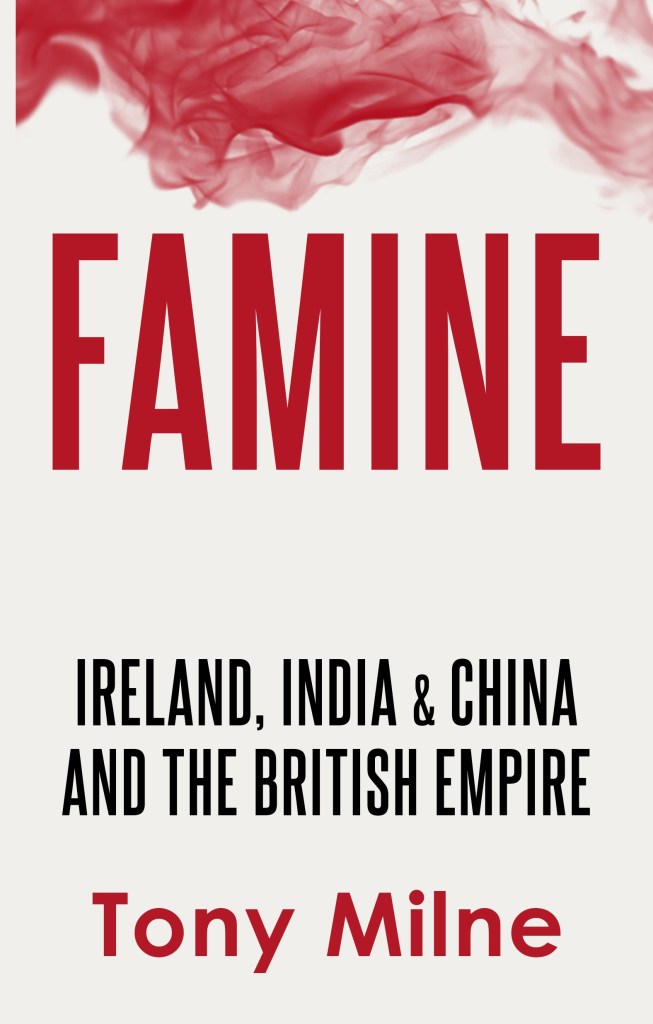
Popularly associated with droughts in sub-Saharan Africa, and charitable ventures to alleviate the suffering, a detailed study of famine shows that famine is mainly the result of government policy and the most effective measure for mitigation once it starts is low-paid work on infrastructure.

Far from being the product of despotic governments, civil wars or natural disasters, famines have most recently occurred under British rule or administration, in countries lavishly supplied by Mother Nature with food.

This book focuses on the famines in Ireland, India and China at times when Britain controlled their tax administration. These three countries provided almost all the profit of the British empire in the 19th Century, yet little has been done to study the impact on those who contributed the most, those most vulnerable to nutritional stress. Apologists for the Empire, even at the time, obfuscated the causes and distributed blame.

To some extent, blaming the natives for their own predicament is reasonable; ascribing responsibility to the individual is the first step towards granting freedom. Britain today, and Europe more generally, is in a situation similar to that of India in 1700 and China in 1500. Once the most powerful, technologically advanced nations in the world, these great empires succumbed to a wave of foreign invasion, conquest and exploitation that resulted in the worst series of natural disasters ever seen.

This book, then, not only presents a historical perspective on one of humanity’s worst self-inflicted disasters, but also provides a warning to complacent citizens and profligate politicians.

Available in hardcover, paperback and ebook, on Amazon and all good bookshops.

WARG Book Review

Many thanks to Janet Backhouse, editor of the Winchester Archaeology and Local History society (WARG) newsletter, for an illuminating review of my book, Myth of England. WARG was set up to protect the ancient artefacts of Winchester’s long history from damage by developers, but has since evolved to become the local amateur history society. Much of the important action of English history took place around Winchester. The capital of the Wessex earls, who came to rule England, it was also the first capital for the Norman kings, who took over the private lands of the Wessex earls as their personal fief. William II Rufus set out from Winchester on his final journey to meet the sharp end of an arrow in the New Forest. King John also set out from Winchester to go to Runymede to sign the Magna Carta. Henry V collected his treasure here before setting out for France on his fateful attempt to marry a French girl. The bishop of Winchester was traditionally the second richest man in England, with a diocese that stretched from the Channel port at Southampton to Southwark on the South Bank of the Thames. Janet’s own vast knowledge of Winchester history added a curious rhyme about King John, which given that it was written by my namesake, A. A. Milne, I should have known, but didn’t.

Myth of England – Debunking the Brexit Bible – Post
Brexit Edition. Tony Milne 2020 pub Handmaid
Books ISBN-13:9798608243073 – Janet Backhouse

I met the author during a course on Human Evolution earlier this year, and was impressed by the depth of his contributions to the Forums and Blogs, where thoughts and opinions on multiple subjects were shared. It was therefore a pleasant surprise when he contacted me with a copy of this book. I am not in the habit of defacing books but I found so much I wished to revisit in this volume that it is littered with pink highlighting.

Whilst history has always been written by the victors, this is the story of a period of 500 years when Monarchs, mainly not English, inflicted swingeing taxation on the populace. At school, I was taught a great deal about the glories of Monarchs and battles won, but never about the infrastructure which supported these – often tyrants – and how they demanded money to fund their exploits, subsequently, often deliberately ruining their creditors to avoid honouring repayment agreements. With the Domesday Book auditing taxation and the Bayeux Tapestry (actually an embroidery probably worked in Canterbury) showing justification for taxation, the lower classes were in for a rough time. William saw
himself as the First King of England, Rex dei gratia, not by election.

We know of William ‘The Conqueror’ defeating King Harold but, not of the apparent enigma. Did you know he never insulted Harold’s memory, hailing him for his bravery? He also banned slavery and capital punishment in England, although castration was permitted, and slaves did not pay taxes anyway!! All this whilst taking from the poor English and giving to the rich Normans, creating an organized system of taxation.

William must also have seen the many advantages of keeping Winchester as the seat of government, building a Castle and Cathedral church. Meanwhile, the Bishop of Winchester levied taxation on merchants by locking the city gates, where he stationed his tax collectors during the sixteen days of St. Giles Fair, and also legislating that no private sales of goods were to be made within seven leagues of the city during that time.

Henry II decided the amount of an amercement (fine) not on the merit of the ‘crime’ but dependent on how much money he needed at the time. A.A. Milne tells us that ‘King John was not a good man – he had his little ways’, and his brother, Richard (The Lionheart) was not the movie hero depicted, but so aggressive and disliked, to the extent his brother offered a ransom, not to have him released from captivity, but to keep him there!

It was not until 1362, when the Statute of Pleading made English the official language for Parliament, that all nobles and the king were required to speak English well enough to conduct official business. It is thought that Henry IV (1367-1413) reigning from 1399, 333 years after the battle of Hastings, was the first English king to speak English as his first language.

Had I more space I would happily continue to add snippets of little known information, such as the precipitation of a supply chain crisis by Edward III, in requisitioning all ships, but I recommend you read it for yourselves.

The River of Gold

The current coronavirus panic is a good moment to remember that the human population has surpassed 7 Billion, and it keeps on rising.  Whatever the personal tragedies, the lockdown will probably increase the population further and faster.  While we cannot colonise the Moon or another planet, our twin hopes lie in global warming and improvements in trade.

Transport, trade and taxation are the themes of the book I am currently promoting, The River of Gold.  We can be sure of one thing, taxes will keep rising.

Available on Amazon worldwide, The River of Gold hit the top 20 historical-geography books on Amazon.com this week (No 17).  Do visit and share your reviews if you have any comment to make.

It also has its own video – check it out on YouTube and leave your comments and likes.