The coronation service of Charles as king of the United Kingdom will include a pledge of allegiance.
It is only 80 years since the Nuremberg Trials in which Germans defended their actions of confiscation, imprisonment, mutilation and murder by claiming that they were merely following their pledge of allegiance and the blind obedience it obliged. Now Britons are lightly invited to swear allegiance. There is no penalty (at present) for those who refuse but, given the current debate about whistle-blowers and the power of authority vested in management and government, it raises the question – is duty to our superiors absolute or should we also consider other duties to ourselves, to our fellow men and women, and to the environment ?
A pledge of allegiance may seem a quaint remnant of a feudal past, a brutal attempt at oppression, or a demand typical of a fuddy-duddy unsure of his place in the world. In behavioural terms, the act of swearing allegiance could be either an autonomic reaction to a humiliating demand wrapped up in ceremonial patriotism, or the careful and cynical output of a cost/benefit analysis, while the choice of resisting or swearing should result in greater fitness for the individual for the behaviour to survive in the population. Could these behaviours result from the same stimulus with merely the experience of the human in question providing the difference ?
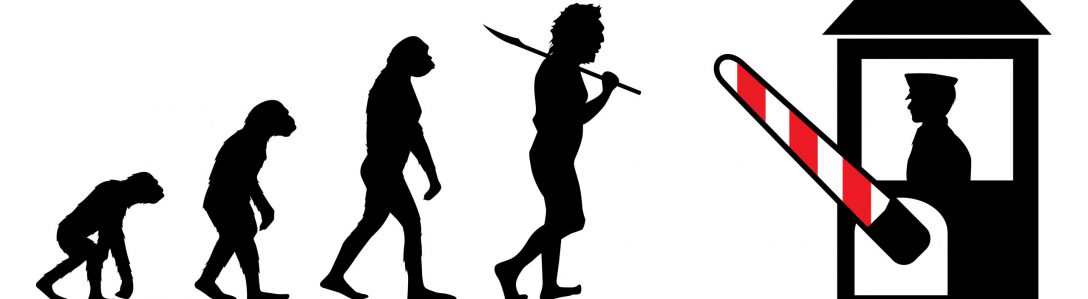
Submission to authority, the overt admission of inferiority, is usually signalled by a pointless or humiliating obeisance. If it were entirely beneficial or immediately profitable, there would be no qualms about pledging. As I describe in my book Tax Man, paying homage to those who claim authority is ingrained in human nature, programmed in our genes. It permits the formation of government, with the first demand for submission being followed by demands for labour or military service, and a financial contribution or supply of produce. The tax revenues and armed forces are the foundation of government.
The first time someone makes a specific demand for submission, an adult male may resist to the extent of using force. Those who demand submission have now thousands of years of experience in managing the process. Any resistance is usually quashed with, if necessary, confiscation, imprisonment, mutilation and even murder, reducing the fitness for survival of a resisting individual by their temporary or permanent removal from the gene pool. Once the submission is gained, governments use the acquiescence to implement taxes, which again, the first time, may need to be enforced violently. It is a trait of humans that, once they have paid a tax once, they continue to pay without question until the tax rate goes up, the name changes or a new tax is introduced. Taxes become customary, like customs. So, the initial demand for submission, even if it is only an invitation to pledge allegiance, has enormous consequences – good and bad – for the individual and for the state.
Submitting to authority as a behavioural trait would not have survived thousands of years of human civilization if it did not grant its actors with greater fitness for survival than they would gain by resisting, or by living in a culture where such demands do not occur. Demographic study of the global population show that the greatest population growth has occurred in areas – China, India/Bangladesh/Pakistan, and north-western Europe – where submission to authority has been greatest. Studies of ruling elites are also pretty convincing that those who strive to operate as tax-collectors are less prolific than simple tax-payers. So, pledging allegiance may be a good thing in the long term for those submitting to the humiliation.
The reason for the demographic success of submission is that human males are aggressive animals who would otherwise fight for territory and mating rights. Nobody would invest in the improvement of land or build roads and bridges or develop new technology, all of which makes life as we know it so good for so many people, unless such investment was protected. The process of submission grants the individual the right to property, work and family without (much) further interference. Typical feudal taxes specifically permitted the individual to sow his corn and harvest the crop, and laws like Magna Carta (now long-since repealed) prevented the government from imprisoning the individual or confiscating his tools so that he could not work. In return, he would be expected to pay his taxes. Women did not have to pay taxes, provide military service or perform corvée labour to build or repair roads and bridges, so they appear rarely in the evolution of these behaviours.
Although submission to older or more powerful males is a normal mammalian trait within the family, it is unusual in intergroup interactions, between strangers, where the normal behaviour is fight/flight/freeze. In such a situation of fight, flight or freeze, it would impossible to cooperate in groups larger than a family. Humans have evolved to inhibit this reaction and substitute it for an aggressive but usually non-violent process of agreeing relative authorities between strangers. Submission to alien authority permits much larger groups of humans to cooperate, to build, trade or invade neighbouring countries, which in turn lead to much more rapid and significant technological changes and improvements in the food supply, sanitation and healthcare. From economic and demographic points of view, therefore, a pledge in itself is a good thing.
Those who criticise the pledge for philosophical reasons may be surprised to discover that they are already guilty of such servile behaviour, eagerly signing up to pledges to democracy, the Labour Party, environmental campaigns, animal activism, vegetarianism, climate emergency or pacifism. Any interaction with government, be it through the police, civil service, or the Inland Revenue, inevitably starts with some equivalent. The police officer will, perhaps politely, issue a request to turn off the car engine or the radio, open the door, or present identity papers. A civil servant will only countenance an interaction with someone who has booked an appointment, or joined a queue, or correctly filled in a form. Teachers have to be addressed as “Sir”, judges as “my Lord”, kings as “Your Majesty”. Any refusal to do so will invite the pre-programmed reaction by the superior authority, which leads quickly through aggression to violence, with the full support of the entire governmental bureaucracy and the general public.
British children grow up with no specific pledge of allegiance to nation, state or sovereign. In addition, there is almost no legal protection of the royal person, hardly surprising in a country where Parliament is a regicide. The laws on high treason (attacks on the king), treachery or even petty treason, such as the prohibition on a wife to attack her husband, have all been repealed, so that, in general, and in theory, we are all equal before the law. However, all Britons today pay taxes, even if the majority of their earnings come from taxes. Acquiescence to taxation is just as much an overt submission to authority as a pledge of allegiance, and just as difficult to refuse after it has been done the first time. Britons also acknowledge government power when requesting a passport or driving licence. Citizenship or residence is essential for even the most menial of tasks especially for foreign travel and formal employment, and beneficial for marriage.
The pledge to the British king is little different from that to Adolf Hitler, promising blind obedience, although the German pledge is explicitly unto death in most Nazi-era oaths. The royal pledge is not overtly so final, but any oath of allegiance implies blind obedience, and blind obedience is only an order away from a suicidal last stand or a murderous raid. Military officers already operate under a pledge of allegiance, granted perhaps passively in the commission document signed by the sovereign, but enforced in daily rituals such as saluting and raising the flag. Civil servants sign their letters to superiors “your humble and obedient servant”. Scouts and guides, police officers, judges, notaries, and immigrants seeking naturalization likewise have to pledge allegiance. British Members of Parliament (MPs and Lords) have to swear allegiance to the sovereign before they can speak, which is why Sinn Fein MPs refused to take up their seats. Curiously, Charles, while still a prince, did not swear allegiance to the Queen as a member of the House of Lords.
Britain’s allegiance to the Crown is replaced in republics by allegiance to the flag and the republic, sworn as in Nazi Germany by schoolchildren. Americans are surprised when they see photos of Britons wearing Union Flag shorts or swimming trunks, which for Americans would be a desecration of the national flag. Most countries have laws prohibiting flag desecration or even interfering with the national anthem, although in Britain desecration of inanimate objects is allowed. In Islamic countries, mockery or even representation of the Prophet or Allah would also be considered desecration and subject to punishment.
While some will swear allegiance to Charles as the head of state, others will swear allegiance to Charles as the head of the Church of England (although he has no formal role in Anglican churches in Ireland or elsewhere).
Only a very few will actively challenge the pledge. Guardian readers, anarchists, and modern thinkers may be surprised to learn from polls that 20% of the British population will make the pledge. Some of these will no doubt mouth the pledge of allegiance while deprecating its importance. This is disingenuous; the importance is that it is done, not overtly refuted. Crossing one’s fingers will not minimise its psychological effect. As far as the human behaviour is concerned, not challenging the pledge is equivalent to making it. Social peer pressure will do the rest. As long as no overt denial is made, it is implicit submission, just as people who witness racist or sexist actions are by their inaction supporting the actions of the perpetrators.
The result of only a small population making the pledge (explicit submission) and a large majority acquiescing (implicit submission) will be a continuation of the monarchy as a component of the British constitution. When individual compliance to a particular situation is sought by government, an explicit submission will be enforced by those who have pledged, supported by the entire edifice. It is difficult as an individual to stand up to the police, prosecutors, judges, a jury, the media and even friends and family.
In a smaller way, pledges of allegiance to a superior in a hierarchy create similar ties of blind obedience and powers of enforcement. The pledge does not need to be overt, it can be just the omission of an overt refusal, or an overt acceptance of some brutal enforcement. It need not be a formal event, such as in a Mafia family, or in a formal document, such as an employment contract. Organisations, especially religious or political ones that do not have a specific profit motive, can easily turn their power of oppression on their employees, customers or neighbours. Critics, who may number only a few, will be powerless to prevent such actions. How can one blow the whistle on someone to whom one owes allegiance ? Especially if, as a result of swearing allegiance, one has gained wealth, influence and a family ?
Life may be unfair, unjust and painful to watch. Oppressive organisations may make individuals suffer. The power of superiors to bend inferiors to their will is unlimited. If history has shown us anything, it is that those individuals involved directly, who are usually the most vociferous in criticising, and those most active in climbing the hierarchy, suffer the most. For the rest of us, observation and seizing the opportunity for a good life is the right strategy.
Recommendation for Saturday ? Switch on the television and enjoy the best soap opera there is, but put in an order for that passport from Paraguay.
 Tony Milne